WHAT IS A TRANSFORMER
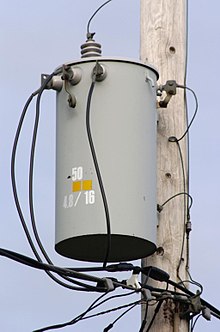
A transformer is a static electrical device that transfers
electrical energy between two or more circuits. A varying current in one coil
of the transformer produces a varying magnetic flux, which, in turn, induces a
varying electromotive force across a second coil wound around the same core.
Electrical energy can be transferred between the two coils, without a metallic
connection between the two circuits. Faraday's law of induction discovered in
1831 described the induced voltage effect in any coil due to changing magnetic
flux encircled by the coil.
Transformers are used for increasing or decreasing the
alternating voltages in electric power applications, and for coupling the
stages of signal processing circuits.
Since the invention of the first constant-potential
transformer in 1885, transformers have become essential for the transmission,
distribution, and utilization of alternating current electric power. A wide
range of transformer designs is encountered in electronic and electric power
applications. Transformers range in size from RF transformers less than a cubic
centimeter in volume, to units weighing hundreds of tons used to interconnect
the power grid.
WORKING PRINCIPLE OF
TRANSFORMER
The working principle of a transformer is very simple.
Mutual induction between two or more windings (also known as coils) allows for
electrical energy to be transferred between circuits. This principle is
explained in further detail below.

TRANSFORMER THEORY
Say you have one winding (also known as a coil) which is
supplied by an alternating electrical source. The alternating current through
the winding produces a continually changing and alternating flux that surrounds
the winding. If another winding is brought close to this winding, some portion
of this alternating flux will link with the second winding. As this flux is
continually changing in its amplitude and direction, there must be a changing
flux linkage in the second winding or coil.
According to Faraday’s law of electromagnetic induction,
there will be an EMF induced in the second winding. If the circuit of this
secondary winding is closed, then a current will flow through it. This is the
basic working principle of a transformer. Let us use electrical symbols to help
visualize this. The winding which receives electrical power from the source is
known as the ‘primary winding’. In the diagram below this is the ‘First Coil’.

The winding which gives the desired output voltage due to
mutual induction is commonly known as the ‘secondary winding’. This is the ‘Second
Coil’ in the diagram above.
A transformer that increases voltage between the primary to
secondary windings is defined as a step-up transformer. Conversely, a
transformer that decreases voltage between the primary to secondary windings is
defined as a step-down transformer.
While the diagram of the transformer above is theoretically
possible in an ideal transformer – it is not very practical. This is because in
open air only a very tiny portion of the flux produced from the first coil will
link with the second coil. So the current that flows through the closed circuit
connected to the secondary winding will be extremely small (and difficult to
measure).
The rate of change of flux linkage depends upon the amount
of linked flux with the second winding. So ideally almost all of the flux of
primary winding should link to the secondary winding. This is effectively and
efficiently done by using a core type transformer. This provides a low
reluctance path common to both of the windings.
Comments
Post a Comment